“You don’t always have to pack your bags to go somewhere new.” – Me, on a particularly lazy Sunday
I have a weird hobby.
I’m not sure what to call it actually.. a hobby, a habit, a tiny act of rebellion against the seismic predictability of adulthood?
Here’s how it works: I open Google Maps, choose a random country, close my eyes (usually not the best move when aiming a mouse), and just drop the pin. If the Google car is available, I click and suddenly, I’m on the move.
Virtually, anyway.
It’s travel in its most stripped-down, chaotic form. No passports, no packing. I’m not chasing five-star reviews or Instagrammable brunches. I’m after the random, the serendipitous (had to chatgpt this word). And, honestly, it’s the best therapy I never signed up for. There’s magic in not knowing where you’ll end up or who you’ll be when you get there.
This week: Kumakogen, Ehime, Japan. Never heard of it? Neither had I.
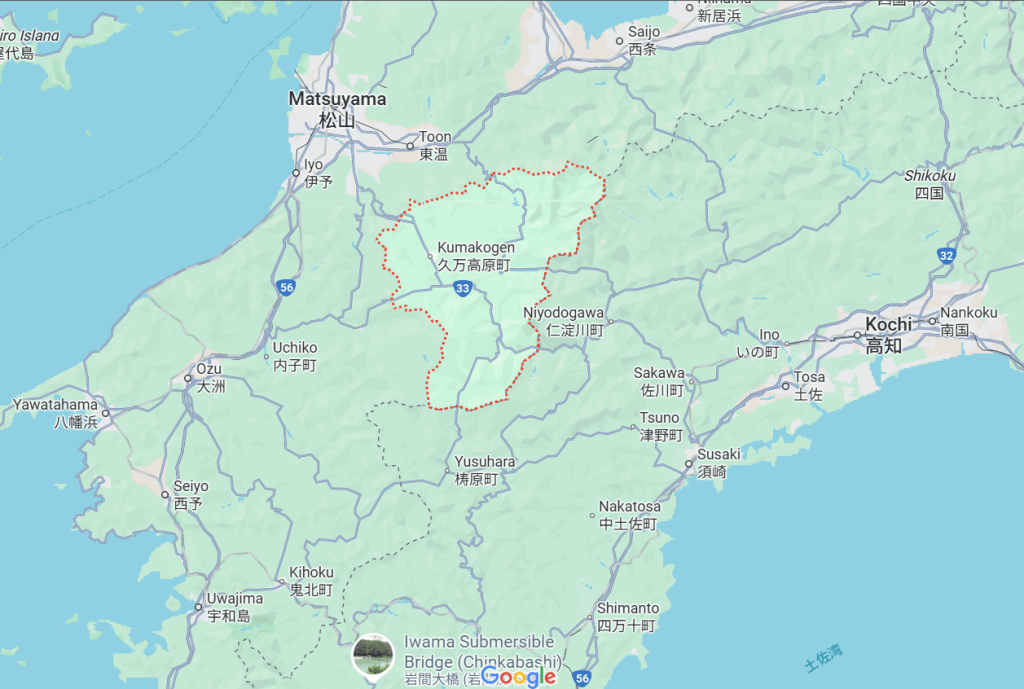
As per Wikipedia, Kumakōgen (久万高原町, Kumakōgen-chō) is a town in Kamiukena District, Ehime Prefecture, Japan. As of 1 August 2023, the town had an estimated population of 6,667 and a population density of about 11.4 persons per km. The total area of the town is 583.69 square kilometres (225.36 sq mi).
Arrival
Suddenly, I’m somewhere rural, somewhere unapologetically itself. Rolling mountains. Clouds big enough to swallow the horizon. Fields that are neat, endless, alive. There, on the edge of it all, a stone statue sits dressed in a bright, red garment. There’s a kind of reverence to it, facing the open land as if standing guard or maybe sharing secrets with the mountains. I stare longer than I expect, sizing up my companion for this visit. Who dresses him? Why red?
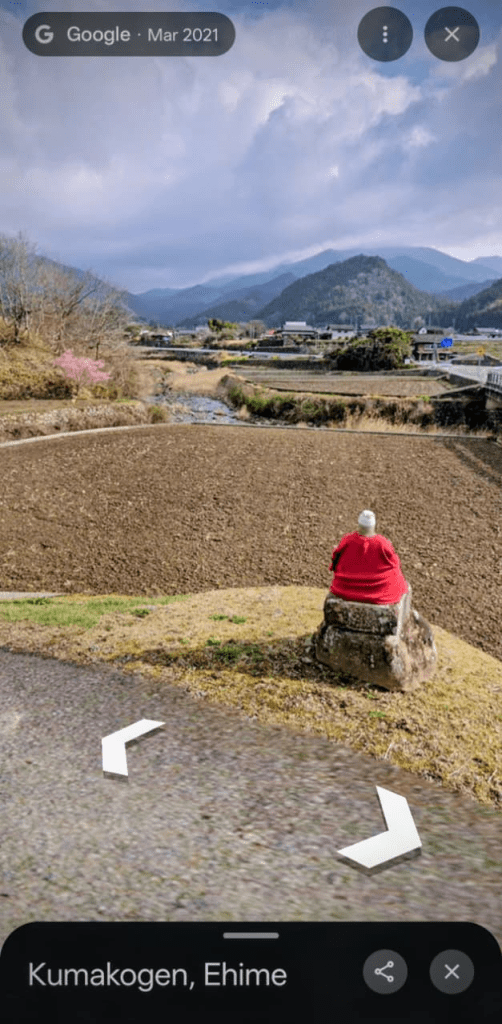
A quick research: These statues are Jizo, guardians of travelers and children in Japanese folklore. They are sometimes dressed in red bibs and hats. In Japan, the color red has been believed since ancient times to ward off evil spirits and protect against illness. Parents often clothe Jizo statues in red as both a show of gratitude and in prayer that Jizo will care for and protect their children. Local people also gift them hats and bibs, not out of duty, but kindness. Protection for wandering souls. I imagine tiny stories echoing at the roots: grandmothers bundling a statue against winter. Children leaving small offerings. Nothing grand, but everything quietly, stubbornly human.
Jizo statues are properly called “Jizo Bosatsu”. They originate from ancient India where they are known in Sanskrit as Ksitigarbha, meaning “earth womb” or “Womb of the Earth”. This name reflects the belief that, just like the earth nurtures and supports all life, Jizo protects and guides people through suffering with deep compassion.
Exploring the Quiet
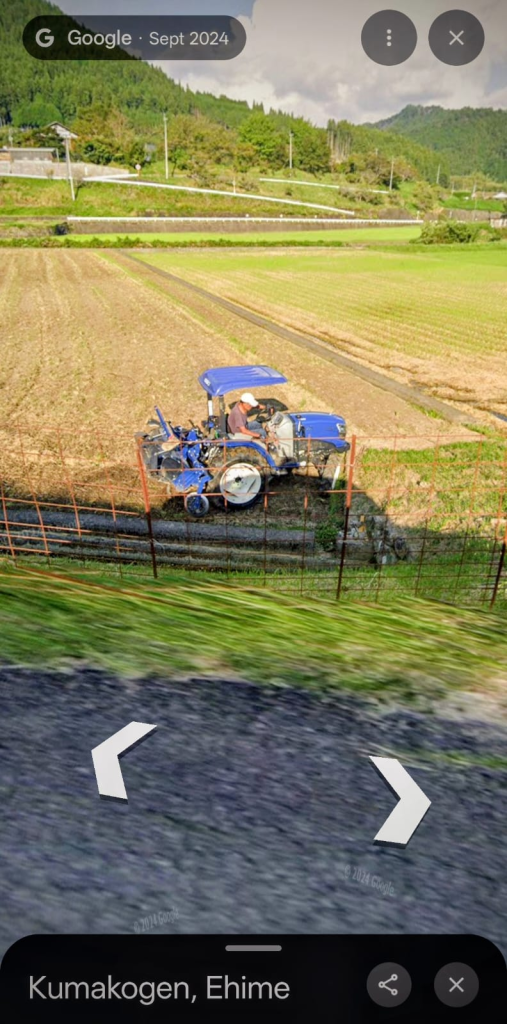
Click forward and the scene changes. The road narrows, vegetation spills over stone embankments, and suddenly a lone tractor rumbles in the autumn sun. The world here feels stubbornly analog, in a way my city heart finds soothing. Everything, from the cropped fields to the hand-built walls, is touched by someone’s careful presence.
I linger. The sky, impossibly blue, threatens to wash my worries clear away.
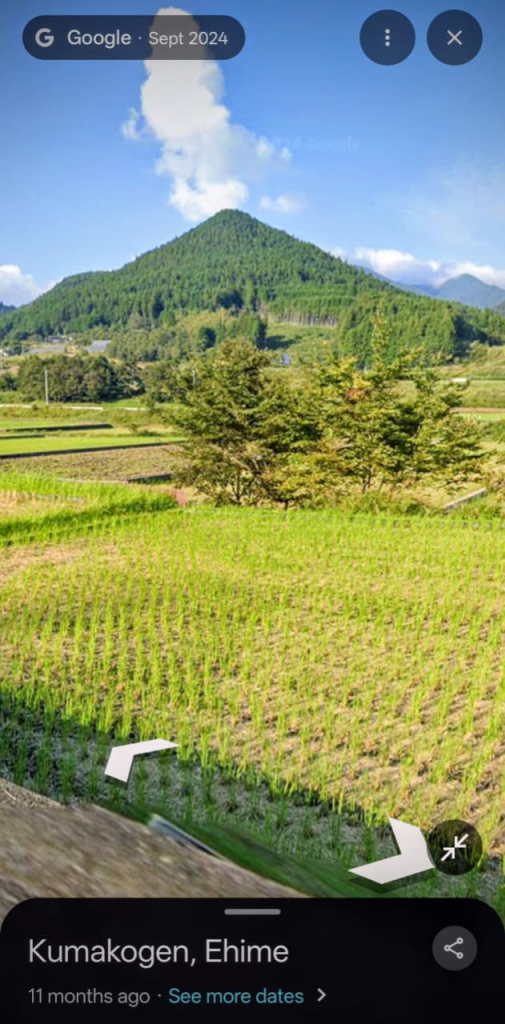
Kumakogen
A real place, with a history Wikipedia only hints at. “Clouds Above the Highlands,” that’s what Kumakogen means. This small town in Japan’s Ehime Prefecture is famous, weirdly, for two things: beautiful winding roads for weekend bikers, and some of the oldest cedar groves in the country.
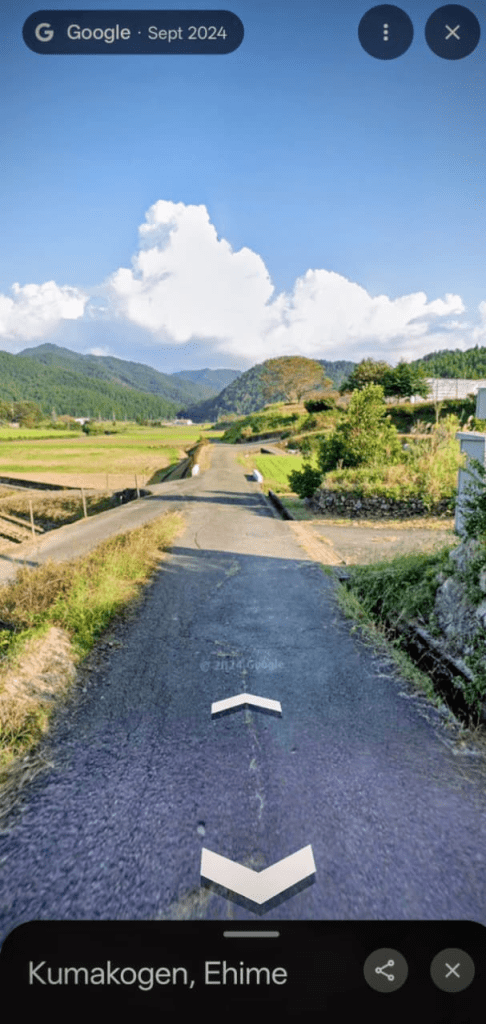
My random virtual stroll barely scratches its surface, but I like to imagine what doesn’t show:
- Locals brewing strong cups of green tea after a long day in the fields.
- Little festivals honoring forgotten mountain gods.
- Stories hushed between neighbors, passed at the bridge, never written down.
Myth or fact? Sometimes, with travel, that’s a blurry line. Some say Kumakogen is haunted by the spirits of travelers who lost their way. Others, more realistically, say “haunted” just means the owls are rowdy after dark.
Why I Wander This Way
The reason I do this? Maybe it’s a hunger for chaos, or maybe it’s about finding small marvels in forgotten corners of the world. There’s comfort in knowing that even in a world neatly mapped and meticulously indexed, some sense of wonder remains if you’re willing to look (with your mouse, at least.)
I save screenshots like postcards: the red-bibbed statue, the farmer in the field, the winding road framed by a giddy sky. These are my proof of arrival, my reminders that there’s always somewhere new to find—even on a day when I barely make it off the couch.
Next week? Who knows. Maybe the frozen villages of Siberia. Or a sun-bleached town in Peru. The world is endless, and the Google car is always waiting.
Here’s to “digital” wandering, unexpected encounters, and the glorious mess of being, well, gloriously, human.
 Rushang Patel
Leave a comment