
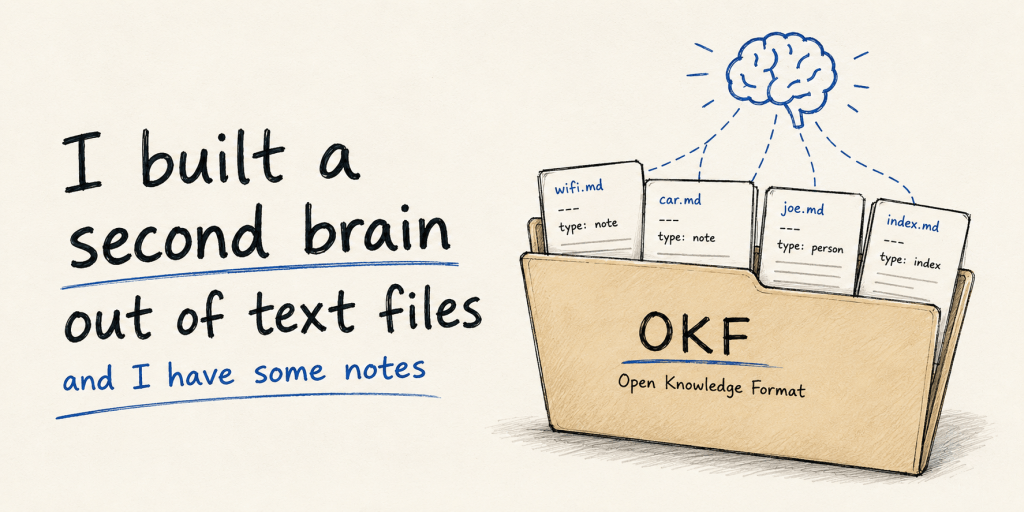
I built a second brain out of text files and I have some notes.
A couple of weeks ago Google released something called the Open Knowledge Format (OKF) – Version 0.1, dated 12 June 2026. No big launch event, no hype. Which is exactly why it’s worth understanding now, before someone turns it into a $499 course with a waitlist.
So let me try to explain what it is, the problem it’s meant to fix, and why it matters.
Start with the simple version, because it really is simple. OKF is a folder of plain text files. Each file describes one thing — a customer database, a sales figure, a step-by-step process for when something breaks, whatever piece of knowledge a company has written down. At the top of each file there’s a tiny bit of labelling (what kind of thing this is, what it’s called), and underneath it, the actual explanation in normal writing. Files can link to each other, the same way one web page links to another.
That’s the whole format. No app to install, no account to log into, no special software. You open a file to read it, and you share it by sending the folder. That’s it. There’s nothing underneath it. It’s just files in a folder.
So why did Google build this?
Think about everything an AI assistant would need to know to be useful inside a company. Where the customer data lives. What “active user” actually means to that business. What to do when a particular system goes down. Right now all of that is scattered everywhere — buried in different tools, half-written in wikis, sitting in someone’s head, tucked into comments inside the code. It’s spread across a pile of systems that don’t talk to each other. So every time an AI needs an answer, it has to go hunting and stitch the pieces together from scratch.
And here’s the deeper frustration, the one anyone who’s worked around software will recognise: every software company stores this stuff in its own way, in its own system, that doesn’t work with anyone else’s. So everyone keeps rebuilding the same thing. The knowledge gets trapped inside whatever tool created it.
OKF’s whole idea is that the fix isn’t another fancy tool, it’s just agreeing on a common, boring format. If everyone writes their knowledge down the same plain way, then anything can read it. One team writes it, a completely different AI can use it, and a person can open the exact same files and read them too. Nobody has to coordinate or buy the same software. That’s the pitch, and it’s a good one.
It’s not even a brand-new idea. Google just put an official stamp on it. People have been doing a version of this for a while, keeping notes in plain text files that AI tools can read. Google took that pattern and wrote down the rules so everyone’s version works together. The point of it: instead of an AI re-reading the same messy documents over and over, you give it one tidy, well-kept library that gets more useful over time. You write it down properly once, and it stays useful.
Here’s roughly what one of these files looks like, so it’s not abstract:
---type: processtitle: What to do when the website goes down---1. Check the status dashboard first.2. If it's the payment system, call the on-call engineer.3. Post an update for customers within 15 minutes.See also: [who's on call this week](on-call.md)
A label at the top, plain instructions below, and a link to a related file. That’s a “concept.” A whole company’s worth of these, sitting in a folder, is the knowledge an AI can draw on.
If you wanted to build one, the steps are refreshingly dull. You make a folder. You write one file per thing you want to capture. You don’t overthink the structure, the format leaves that up to you. The one and only rule is that every file has to say what kind of thing it is which is a single label at the top. Everything else (a title, a short description, tags, a date) is optional but handy. Then you link related files to each other, because that’s what turns a plain folder into something an AI can find its way around. When you’re done, you just keep the folder somewhere — a shared drive, a code repository, wherever — and point an AI at it.
Now the honest caveats, because you can already feel the hype building, and someone’s going to repackage “write your notes in a tidy folder” as a secret methodology with a webinar attached.
It’s an early version, and Google itself calls it “a starting point, not a finished standard.” There are obvious gaps still to sort out. And right now, basically everything that uses OKF was built by Google, which makes this more of an invitation than a movement. Whether it catches on depends entirely on other companies actually picking it up, and that’s far from certain.
It’s also worth seeing the business angle clearly. The format itself is free and open, but it’s the front door to something Google sells. They’ve wired OKF into a paid product of theirs that stores and serves all this knowledge at scale. Give away the simple part, sell the heavy machinery behind it. It’s a smart move, and worth naming so nobody pitches OKF to you as pure generosity.
For all that, the core idea is solid and the barrier to trying it is basically nothing. It’s a sensible, plain, open way to hand knowledge to AI without locking it inside anyone’s product. Which is exactly why it might work.
Sources


Leave a Reply