• Christos Tzolis to Arsenal: Will He Actually Fit?

    Norwich City signed Christos Tzolis in 2021 for about £8m. He was 19, billed as a Greek wonderkid, and within a year he’d played barely any Premier League football and been shipped off to Germany on loan. That’s the part of the story most people forget. Arsenal are now paying roughly £32m to bring him back to England, and the obvious joke writes itself: didn’t this already not work?

    It didn’t. But the player coming back is not the player who left, and the interesting question isn’t whether he’s good now. He clearly is — 17 goals, 23 assists, and the Belgian Pro League Player of the Season award will tell you that. The real question is whether what he’s good at matches the specific job Arsenal need doing. Because Leandro Trossard has gone to Beşiktaş, and that leaves a very particular hole.

    What kind of player is Christos Tzolis?

    Tzolis is a 24-year-old inverted left winger — right-footed, cuts inside, plays off the left. He is not a touchline sprinter who beats his man and crosses. His whole game is about drifting inside and getting into scoring positions himself.

    You can see it in one number that rarely gets quoted: 289 touches in the opposition box last season, around 8.5 per game. That’s a striker’s number, not a winger’s. He doesn’t hold width and wait for the play. He gets into the eighteen-yard box and arrives on the end of things.

    This matters because it’s exactly what Arsenal’s left forward is asked to do. In Arteta’s setup, the left-back or a midfielder provides the width, and the winger tucks inside into the space between defenders. That was Trossard’s job. Tzolis already plays that way — so he wouldn’t need reprogramming into the role, which is often where these transfers quietly fail.

    Are his goals real, or just a hot streak?

    They’re real. This is the number that should reassure Arsenal fans most.

    Tzolis scored 17 league goals from 17.60 expected goals (xG). In plain terms, he scored almost exactly what his chances were worth. He isn’t a player riding a lucky finishing run that’s about to dry up. The goals come because he keeps getting into good positions, not because he’s converting half-chances at an unsustainable rate.

    That’s an important distinction. Finishing streaks don’t survive a move to a tougher league. Good positioning does, because it’s a habit, not a fluke.

    Is Tzolis more of a creator or a scorer?

    He may actually be the better creator, and it’s the most underrated part of his game. He recorded 23 assists and created 25 big chances last season.

    You don’t rack up 25 big chances by crossing from wide. You do it from the half-space — the channel between the full-back and centre-back — which is the exact zone Arsenal try to attack. A player creating at that volume is a player who reliably finds the ball in dangerous central areas and picks the right pass.

    Some of those assists will dry up — his teammates finished at a high rate that won’t last forever. But where he creates from won’t change, because that’s about his movement, not their finishing.

    What are the warning signs?

    Here’s where an honest assessment has to slow down, because the same style that makes him fit also carries the risk.

    His shooting accuracy is low. He took 3.6 shots per game but only hit the target with 1.3 of them — about 36%. He shoots a lot and misses the target often. In Belgium, where he gets time on the ball, that volume turns into goals. In the Premier League, where defenders close down faster, that extra half-second disappears. He needs time in the box, and the Premier League is where time runs out quickest.

    The Champions League is the real red flag. Against Europe’s best last season, Tzolis started eight group games and scored once from 20 shots. Against Manchester City: four shots, no goal. That’s the closest thing we have to a Premier League test, and he went quiet — because against elite defences, the space he feeds on shrinks. Brugge were outmatched and he was carrying a back injury, both fair mitigations. But the one real test of “can he do it against top teams” didn’t go well, and that has to be said plainly.

    His body is a question too. That recurring back injury cost him games late in the season. His entire value is built on volume — lots of touches, lots of chances, stacked up across a full campaign. Volume needs availability. A fit Tzolis and an injured Tzolis are two very different signings.

    Christos Tzolis 2025/26 stats

    StatTotalPer 90
    Goals170.50
    Expected goals (xG)17.600.51
    Assists230.67
    Big chances created250.73
    Shots1233.60
    Shots on target441.29
    Touches in opposition box2898.47
    Successful dribbles40 (50.6%)1.17

    Champions League: 8 starts, 1 goal from 20 shots.

    So will Tzolis be a good signing for Arsenal?

    It comes down to what Arsenal think they’re buying.

    If they’re buying a replacement for Trossard — a clever, two-footed forward who fits straight into the left-sided role, chips in goals and assists, and rotates across the front line — then £32m for a 24-year-old is a good, sensible deal. Everything in his game says he’ll look at home in the shape of Arsenal’s play from day one.

    If they’re expecting a star who carries the attack in year one, the numbers say be patient. The shooting needs to get sharper against better defenders, and the Champions League showed what happens when the space gets taken away.

    The honest verdict is that Tzolis fits the system better than almost anyone Arsenal could have signed for the money — and whether he becomes more than a useful squad player depends on two things a spreadsheet can’t predict: how fast he adapts to having less time on the ball, and whether his back lets him play enough games to adapt at all.

    Norwich bought a wonderkid and it didn’t work. Arsenal are buying something much less romantic and much more useful — a player who fits. That’s usually the better bet.

  • The Ronaldo Problem

    The Ronaldo Problem

    Ronaldo went out of the World Cup on Monday, crying, at 41, beaten by a goal in the 91st minute (MIKEL MERINO!). I kinda felt bad for him for about a day and then spent the rest of the week stuck on something else, which is that I have never worked out whether a player is allowed to be bigger than the team.

    Everyone says no. It’s basically a commandment. Nobody is bigger than the club. Ferguson built 26 years on it. Sold Stam, sold Beckham at peak Beckham, moved Van Nistelrooy on while he was still scoring goals. Meanwhile the club’s best-selling product was a shirt with one man’s name on the back of it. So the commandment is a bit convenient, is all.

    Here’s the thing I got stuck on.

    Every team wants no single point of failure. Every person wants to be one.

    Corporate people have a name for the first half of that. They call it the bus factor: how many people would have to get hit by a bus before the project dies. A bus factor of one means one person walks out and everything stops. It’s considered an emergency. Teams hold meetings about it. There are dashboards.

    And in the same building, in a different meeting, someone is being told to make themselves indispensable.

    That’s the whole thing, and I don’t think anyone’s ever put those two conversations in the same room on purpose. A good team is one where nobody matters too much. A good career is becoming the person the thing can’t run without. We tell people to be irreplaceable, then we build systems to make sure nobody is, and then we’re surprised when someone actually pulls it off and it becomes a problem.

    There’s a cruel joke buried in it, too. Make yourself truly indispensable at work and you will not get promoted. You can’t be. You can’t be moved, because moving you breaks something. The reward for becoming the single point of failure is getting to stay exactly where you are, forever, being extremely important.

    Anyway. Football.

    The commandment is annoyingly well-supported. Bill Simmons named a whole theory after it – the Ewing Theory. Patrick Ewing was the Knicks. Everything went through him for fifteen years. Then in 1999 he got hurt in the playoffs and the Knicks, without him, went to the Finals. Simmons’ point was that this keeps happening: a team quietly gets better when the star goes, because the star had trained everyone around him to wait.

    That’s the version of “too big for the team” nobody wants to say out loud. Not that the star was bad. That the ten others had slowly learned to stand still.

    Which brings me to Arsenal, because of course it does.

    We won the league this year. First time in 22 years, and we won it in the most anti-star way you could possibly design. 19 clean sheets. 27 goals conceded, best defence in the country. Someone on Sky called us “a team of corners and Gabriel goals,” meaning it as an insult, and I have decided to have it printed on a mug. Nobody carried us. In the Champions League final Arteta even started Havertz ahead of Gyökeres, the expensive summer signing, the actual marquee striker we craved for. Havertz scored in six minutes.

    Bus factor: high. Textbook. 22 years of hurt ended by a team with no single point of failure.

    And then Budapest.

    1-1 after 120 minutes. Penalties. And it comes down to Gabriel, who had been our best player on the pitch, who had spent two hours throwing his body in front of everything PSG had, standing on the spot, alone, with the entire thing on him. He put it over the bar. Pulled his shirt over his face.

    Twenty-six men build a season for ten months, and then football walks one of them out to a spot twelve yards from goal and makes him do it by himself in front of eighty thousand people.

    That’s the part that broke my theory, and I’ve been sat with it for six weeks.

    Because penalties aren’t a design flaw. The sport does that deliberately. You can build the perfect collective, the system with no weak link, the club where no one is bigger than the badge, and at the end, the game will still find the one man and put the whole thing on him. It insists on it. Every knockout tournament ends with the possibility of one person, alone, in silence, deciding everything.

    So maybe the collective was never actually in charge and we just prefer the story where it is.

    And I think that’s what sport is quietly for. It’s the last place we still say, with a straight face, that the badge matters more than the name. Everywhere else runs on the exact opposite rule. Your salary rewards being irreplaceable. Your promotion, your credit, whose name goes on the work. We spend every weekday trying to become the single point of failure, and then on Saturday we get morally offended watching someone succeed at it.

    Ronaldo says Portugal won nothing before him. He’s right. He also went off injured 25 minutes into the 2016 final and they won it without him, and he was right there on the touchline, waving his arms, directing traffic, absolutely central to a thing that happened without him.

    So which is it. Is he the reason, or was he standing nearby when it happened?

    I don’t know, and I’ve stopped believing anyone who says they do. What I’ve noticed instead is that I’ve started checking my own bus factor at work, properly, honestly, and I don’t love the answer, and I’m not sure whether the thing I don’t love is that it’s too low or that it’s too high.

  • Open Knowledge Format (OKF): It’s Just a Folder, and That’s the Point

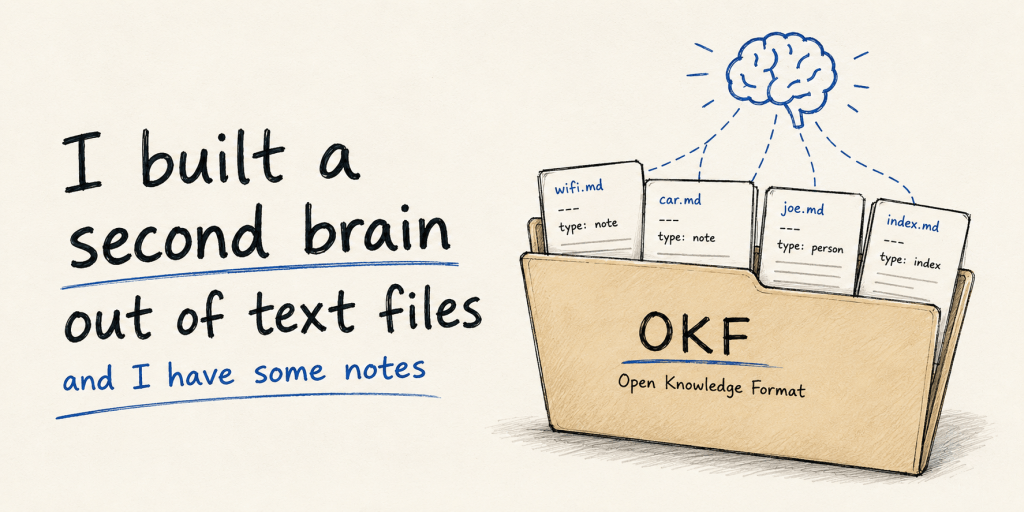
    I built a second brain out of text files and I have some notes.

    A couple of weeks ago Google released something called the Open Knowledge Format (OKF) – Version 0.1, dated 12 June 2026. No big launch event, no hype. Which is exactly why it’s worth understanding now, before someone turns it into a $499 course with a waitlist.

    So let me try to explain what it is, the problem it’s meant to fix, and why it matters.

    Start with the simple version, because it really is simple. OKF is a folder of plain text files. Each file describes one thing — a customer database, a sales figure, a step-by-step process for when something breaks, whatever piece of knowledge a company has written down. At the top of each file there’s a tiny bit of labelling (what kind of thing this is, what it’s called), and underneath it, the actual explanation in normal writing. Files can link to each other, the same way one web page links to another.

    That’s the whole format. No app to install, no account to log into, no special software. You open a file to read it, and you share it by sending the folder. That’s it. There’s nothing underneath it. It’s just files in a folder.

    So why did Google build this?

    Think about everything an AI assistant would need to know to be useful inside a company. Where the customer data lives. What “active user” actually means to that business. What to do when a particular system goes down. Right now all of that is scattered everywhere — buried in different tools, half-written in wikis, sitting in someone’s head, tucked into comments inside the code. It’s spread across a pile of systems that don’t talk to each other. So every time an AI needs an answer, it has to go hunting and stitch the pieces together from scratch.

    And here’s the deeper frustration, the one anyone who’s worked around software will recognise: every software company stores this stuff in its own way, in its own system, that doesn’t work with anyone else’s. So everyone keeps rebuilding the same thing. The knowledge gets trapped inside whatever tool created it.

    OKF’s whole idea is that the fix isn’t another fancy tool, it’s just agreeing on a common, boring format. If everyone writes their knowledge down the same plain way, then anything can read it. One team writes it, a completely different AI can use it, and a person can open the exact same files and read them too. Nobody has to coordinate or buy the same software. That’s the pitch, and it’s a good one.

    It’s not even a brand-new idea. Google just put an official stamp on it. People have been doing a version of this for a while, keeping notes in plain text files that AI tools can read. Google took that pattern and wrote down the rules so everyone’s version works together. The point of it: instead of an AI re-reading the same messy documents over and over, you give it one tidy, well-kept library that gets more useful over time. You write it down properly once, and it stays useful.

    Here’s roughly what one of these files looks like, so it’s not abstract:

    ---
    type: process
    title: What to do when the website goes down
    ---
    1. Check the status dashboard first.
    2. If it's the payment system, call the on-call engineer.
    3. Post an update for customers within 15 minutes.
    See also: [who's on call this week](on-call.md)

    A label at the top, plain instructions below, and a link to a related file. That’s a “concept.” A whole company’s worth of these, sitting in a folder, is the knowledge an AI can draw on.

    If you wanted to build one, the steps are refreshingly dull. You make a folder. You write one file per thing you want to capture. You don’t overthink the structure, the format leaves that up to you. The one and only rule is that every file has to say what kind of thing it is which is a single label at the top. Everything else (a title, a short description, tags, a date) is optional but handy. Then you link related files to each other, because that’s what turns a plain folder into something an AI can find its way around. When you’re done, you just keep the folder somewhere — a shared drive, a code repository, wherever — and point an AI at it.

    Now the honest caveats, because you can already feel the hype building, and someone’s going to repackage “write your notes in a tidy folder” as a secret methodology with a webinar attached.

    It’s an early version, and Google itself calls it “a starting point, not a finished standard.” There are obvious gaps still to sort out. And right now, basically everything that uses OKF was built by Google, which makes this more of an invitation than a movement. Whether it catches on depends entirely on other companies actually picking it up, and that’s far from certain.

    It’s also worth seeing the business angle clearly. The format itself is free and open, but it’s the front door to something Google sells. They’ve wired OKF into a paid product of theirs that stores and serves all this knowledge at scale. Give away the simple part, sell the heavy machinery behind it. It’s a smart move, and worth naming so nobody pitches OKF to you as pure generosity.

    For all that, the core idea is solid and the barrier to trying it is basically nothing. It’s a sensible, plain, open way to hand knowledge to AI without locking it inside anyone’s product. Which is exactly why it might work.

    Sources

  • Why Do They Actually Hate Arsenal?

    I’ve tried pretending it’s just rivalry. It isn’t.

    There’s something about Arsenal Football Club that presses on people in a specific way. Not just opponents. Neutrals too. You can see it in the replies. In the quote tweets. In the way a harmless celebration clip turns into a 3,000-comment courtroom drama where someone from Manchester is genuinely furious about offside.

    It’s disproportionate.

    And if I’m honest, I think I finally understand why. It took me a while because I kept looking for the wrong thing. I kept looking for something we’d done. Turns out the crime is something we are.

    We Talk Like We’re Inevitable

    That’s the real crime.

    Arsenal fans don’t speak like hopeful underdogs. We speak like historians correcting a temporary error. There’s a baseline assumption in everything we say — that the natural state of football involves Arsenal near the top of it, and whatever is currently happening is an anomaly, a weather event, a clerical mistake that will shortly be resolved.

    We don’t say, “Maybe this is our year.” We say, “Order is being restored.”

    This was maddening during the Wenger out years, when we were finishing fifth and genuinely debating whether Mustafi was a top-four centre-back. We were still using the language of a club between dynasties rather than a club in genuine trouble. Other supporters noticed. They found it hilarious. They still find it hilarious — except now we’re actually pushing for titles, which makes the confidence less funny and more aggravating.

    Even during the banter era, we carried ourselves like a sleeping aristocracy. That irritates people. Confidence without recent dominance feels illegal in football culture. You’re only allowed to swagger if you’ve just lifted something heavy and silver.

    We swagger on principle.

    We Romanticize the Game

    Other clubs celebrate winning. We celebrate patterns of play.

    We will replay a 17-pass sequence — the Saka to Martinelli to Ødegaard triangle, the one that went absolutely nowhere and ended with a goal kick — and call it football heritage. We treat build-up play the way music critics treat a b-side that the mainstream missed. We argue about half-spaces at 1:30am. We post Opta maps. We say things like positional structure without even slightly lowering our voice.

    To us, that’s love of the craft.

    To everyone else, it’s a grown adult explaining wine to someone who just wanted a drink.

    It sounds like we think we understand football at a higher level. Sometimes we’re right, and that almost makes it worse. Nobody wants to be condescended to correctly. You can be wrong and annoying, that’s forgettable. But being right while also being annoying — that sticks. That’s the kind of thing people remember at 2-0 down.

    The Near-Miss Aura

    Here’s where it gets psychological.

    Consistent winners become villains. Consistent losers become irrelevant. Consistent almost-winners become obsession material — because almost-winners have a story that keeps going, a wound that never quite closes, a next chapter that people can’t stop wanting to read even when they’re rooting against it.

    Arsenal live in the almost.

    Think about 2022-23. We led the league by eight points in March. Eight points. And then we didn’t. The way that unravelled — not in a single catastrophic night but slowly, agonisingly, across weeks of tightening results and post-match press conferences where Arteta kept saying the right things with his jaw slightly too tight — felt almost scripted. It was the kind of collapse that gets its own documentary. People who don’t care about Arsenal were watching that run-in like a season finale.

    We rise beautifully. We collapse dramatically. We rebuild with cinematic pacing. The storyline is always tense, always unresolved, always one good month away from either vindication or another spectacular implosion. People watch us the way they watch a show where they’re not sure if they want the protagonist to succeed. And when the plot twists? The memes write themselves. They’ve had plenty of practice.

    The pleasure rivals take in our slip-ups isn’t random. It’s narrative payoff. We are the ones who created the tension. We have nobody to blame for the catharsis but ourselves.

    We’re Loud Online

    There’s no escaping this one.

    Arsenal Twitter is not a community. It’s a weather system with a persecution complex and a Substack.

    A refereeing decision becomes a thesis. A post-match interview becomes philosophy. A title race becomes destiny versus a corrupt establishment that has never, not once, wanted to see Arsenal succeed. When we lose, it is suspicious. When we win, it is merely the universe correcting itself. When VAR goes against us — and VAR does go against us, genuinely, the data is there — it becomes confirmation of something we already believed.

    We don’t do quiet suffering. We do forensic breakdowns. We do threads. We do parallel timelines where the linesman’s flag stays down and everything is different. We are not people who watch football and feel feelings. We are people who watch football and produce content.

    And because our online presence is enormous, the loudest five percent represent all of us in the public imagination. The screenshots travel. The worst takes go viral. The normal fans — the ones watching quietly, occasionally saying oh good goal, doing the washing up at half-time — stay completely invisible. Nobody screenshots reasonable.

    Scale magnifies perception. And we have scale.

    We Don’t Fit the Clean Villain Box

    Every big club gets hated, but the reason has to make sense or the hatred can’t sustain itself.

    City are hated for dominance — for making the league feel like an inevitability, a foregone conclusion, a very expensive formality. United are hated for history — for the decades of success people feel they’ve never quite been made to answer for. Chelsea are hated for money — for the Roman Abramovich years, for the sense that trophies were simply purchased and delivered like furniture.

    These are clean hatreds. They have a clear source. You can point at the thing.

    Arsenal? We’re hated for posture.

    We talk about tradition, about aesthetics, about the identity of the club, about the Arsenal way — things that sound noble until they start to sound like we’re filing a formal objection to reality. We hold ourselves to standards that can read as moral superiority. We lose and still manage to imply that we lost more thoughtfully than other clubs win. When you combine that with not having actually sealed the deal recently, the whole performance reads as either profound conviction or spectacular self-delusion.

    The maddening part — and I say this as someone inside the tent — is that we’re not entirely sure which one it is either.

    Envy Without Admission

    Here’s the part nobody says out loud.

    Arsenal fans believe deeply. Not casually, not ironically, not in the mild way you support a team without really wanting to examine what that means. Deeply. Embarrassingly. The kind of belief that survives mid-table finishes and makes people on the internet question your grip on reality. The kind that keeps producing the next generation of fans who come in expecting greatness and somehow leave more convinced than they arrived.

    There is something unsettling about watching a group hold onto that faith through years of open mockery, and then slowly — slowly enough that you almost missed it — start to see it justified. It forces a choice in observers. You can laugh again, which is easy, which costs nothing, which keeps the dynamic comfortable. Or you can admit that they might be building something real, which requires updating your understanding of what’s happening, which requires a kind of intellectual honesty most football rivalries don’t incentivise.

    Mockery is cheaper. Mockery scales. Mockery requires no revision.

    Hatred is often just envy that found a socially acceptable outfit. And the most revealing thing about the hatred Arsenal attracts right now is that it’s louder than it was five years ago, when we were finishing eighth. You’d think less success would mean more ridicule. But it doesn’t work that way. The closer the belief gets to being vindicated, the more urgent it becomes to make sure everyone still thinks it’s ridiculous.

    Are We the Most Hated?

    In this moment? It feels like it.

    Not because we’re evil. Not because we buy titles or bend rules or play without a kind of recognisable joy. But because we’re hovering close enough to power to make people nervous — and we’ve been hovering long enough that the nervousness has curdled into something more committed.

    Football hate is proximity-based. The closer you get to lifting something, the louder the resistance becomes. It’s a strange kind of recognition, if you squint at it right.

    Indifference would worry me more. Truly. When people track your fan accounts and clip your celebrations and bookmark your bad takes and build whole segments of their personality around waiting for you to slip — you are not irrelevant. You are not a joke. You are a threat wearing the costume of a joke, which is a much more interesting thing to be.

    They don’t hate Arsenal.

    They hate the possibility that the belief was never delusional. That it was just early.

    And they hate that they can’t stop watching to find out.

  • I Survived an Elevator Ride
    This is Fine Meme

    I was standing in an elevator about twenty minutes ago listening to the Black Eyed Peas. 22nd floor going down. And I had this thought: what if this thing just… stops working?

    What if right now, mid-descent, something snaps?

    It wasn’t panic, exactly. More like this sudden, sharp awareness that I’m basically trusting my entire existence to engineering I don’t understand, maintained by people I’ve never met, governed by physics I learned about once in high school and promptly forgot.

    And then my mind did what minds do when you give them an inch. It spiraled.

    What about that air conditioner hanging outside the third-floor window I walked past earlier? What if the bolts are rusty? What if today’s the day it decides gravity wins?

    We live like this every single day and we just… don’t think about it.

    The Illusion We’re All Pretending to Believe

    We’ve constructed this entire life around the assumption that we’re in control. We meal prep on Sundays. We set five-year goals. We argue about the best morning routines like optimizing our first two hours will somehow bulletproof us against the universe’s randomness.

    And look, I’m not saying don’t plan. I’m not suggesting we all become nihilists who stop brushing our teeth because “what’s the point, an asteroid could hit us tomorrow.”

    But there’s something almost… innocent? Naive? About how hard we clutch at control.

    You make the healthy choice at lunch. You take the stairs for exercise. You’re building toward something, right? Except you’re also walking under air conditioners that could fall. You’re trusting brake systems in cars driven by strangers who might be texting. You’re assuming your heart will keep beating in the next five seconds because it’s beaten for every five seconds before this.

    That assumption feels solid until you really look at it.

    The Elevator Moment

    That elevator ride became this weird meditation on trust. Not in any spiritual sense, but just… practical trust. I’m trusting:

    1. The maintenance schedule was followed
    2. The inspector actually checked the cables last month
    3. The building manager didn’t cut corners
    4. The company that installed this thing ten years ago did it right
    5. Physics will continue working the way it worked yesterday

    And I realized that this is everything. This is how we move through the world.

    You get on a plane. You eat food prepared by strangers. You drive past eighteen-wheelers at seventy kms per hour with three feet of space between your fragile human body and their cargo. You assume the person walking behind you on a dark street is just walking, not planning anything.

    Most of the time? You’re right. The elevator works. The AC stays bolted to the wall. The day unfolds exactly as boring as you expected.

    But sometimes it doesn’t.

    What We Actually Control (Spoiler: It’s Almost Nothing)

    I think we overestimate our sphere of influence by a factor of about a thousand.

    We control our choices. Our reactions. Our effort. That’s basically it.

    Everything else? It’s probability dressed up as certainty.

    You can eat clean for twenty years and still get the bad diagnosis. You can drive perfectly and get hit by someone who didn’t. You can be the kindest person in the room and still lose people you love to randomness that has nothing to do with fairness or deservingness or karma.

    The universe isn’t out to get you, but it’s also not particularly concerned with protecting you.

    Accepting this isn’t depressing. Actually, I think fighting it is what’s depressing.

    The Exhaustion of Pretending

    Think about how much energy we spend trying to control things we can’t control.

    You check your whatsapp messages forty times hoping the response appeared. You refresh the tracking number like your attention will make the package arrive faster. You replay the conversation, thinking if you’d just said the right thing, the outcome would’ve been different.

    Maybe. Or maybe the outcome was always going to be what it was, and you’re just torturing yourself with the fantasy of control.

    I’ve watched people twist themselves into anxious knots trying to manage every variable. If I just prepare enough, anticipate enough, worry enough, I can prevent the bad thing.

    Except you can’t. The AC falls or it doesn’t. The elevator cable holds or it doesn’t. Your body cooperates or it decides today’s the day for a curveball.

    You know what’s actually in your control in that elevator? How you stand there. Whether you’re doom-scrolling or taking a breath. Whether you’re present for those thirty seconds or absent, lost in the past or future.

    That’s it. That’s the whole empire of your influence.

    Living Like You Believe It

    So what do you do with this? How do you live when you really accept that the floor could drop out at any moment?

    I don’t know.

    I mean, I don’t. I wish I had some tidy answer here, some three-step process for making peace with uncertainty. But I’m standing here the same as you, trying to figure out how to walk around knowing that everything’s held together by probabilities and trust in things I can’t verify.

    Some days I think I’ve got it. I feel loose, present, okay with not knowing. I take the elevator and don’t think twice. I walk under buildings. I make plans for next month like next month is guaranteed.

    Other days? The thought creeps in and I can’t shake it. What if today’s the day something goes wrong? What if I’m just lucky until I’m not?

  • Humanity’s Most Efficient Networking Tool

    I am not a smoker. This matters, because it places me permanently on the inside of buildings, staring through glass doors like a house cat while an entire parallel society flourishes just outside.

    Over time, I’ve noticed something that may be obvious to everyone except people who don’t smoke: smokers appear to have a remarkably active social life. Not necessarily better, but definitely more coordinated.

    Smokers always know where everyone is. They disappear from a party in pairs and reappear ten minutes later with new friendships, inside jokes, and occasionally someone’s lighter. I go to refill my water bottle and return alone, unchanged, spiritually the same.

    There’s something about “going out for a smoke” that functions as a social spell. No agenda required. No RSVP. No icebreaker. The cigarette does the administrative work. You don’t have to say, “Shall we meaningfully connect for five minutes?” You just say, “Smoke?” and suddenly you’re bonding over weather, work, and the shared understanding.

    And then there’s the sharing. Smokers are constantly exchanging things. A lighter. A cigarette when someone’s pack runs out. A light in the wind when someone cups their hands around the flame. These are small gestures, but they add up to something that looks a lot like friendship. By the third time you’ve borrowed someone’s lighter, you’re basically obligated to know their life story.

    Non-smokers can bond too, obviously. We’re perfectly capable of forming deep connections. But we have to work for it. We need shared interests, repeated interactions, maybe a book club or a group chat that slowly dies over six months. Smokers skip all that. They have a built-in ritual that doubles as an excuse to stand close to strangers and talk about nothing until it becomes something.

    I’ve watched people become best friends in a smoking area over the course of a single wedding. By the reception, they’re already planning a trip together. Meanwhile, I’ve been sitting at the same table all night with someone I went to college with, and we’re still stuck on “So, how’s work?”

    As a non-smoker, my breaks are inefficient. I “step outside for some air,” which sounds suspiciously like loitering with hope. Smokers have a clear mission, a timeline, and props. They stand in circles that look accidental but aren’t. They rotate conversational roles with the ease of people who have practiced this exact formation hundreds of times.

    Smoking areas may be the last remaining socially acceptable liminal spaces. Offices have them. Weddings have them. Even nightclubs, which are already loud, dark, and confusing, somehow require an extra outside zone where people can finally hear each other. Important life decisions may or may not be made there. I cannot confirm.

    I suspect the real secret isn’t the smoking, but the permission structure around it. Smokers are allowed to leave. Repeatedly. Guilt-free. They’re never accused of being antisocial; they’re “just stepping out”. Non-smokers who do the same are “wandering” or “processing something”.

    I don’t want to smoke. Based on available medical evidence, this seems wise. But I do sometimes envy the efficiency with which smokers manufacture community out of thin air and nicotine. If nothing else, they’ve solved a problem the rest of us are still workshopping: how to briefly escape a situation and make friends.

    If society ever figures out how to give non-smokers a socially sanctioned reason to disappear in small groups, smokers may finally lose their monopoly on accidental intimacy. Until then, I’ll be inside, wondering what jokes are happening just beyond the door.