
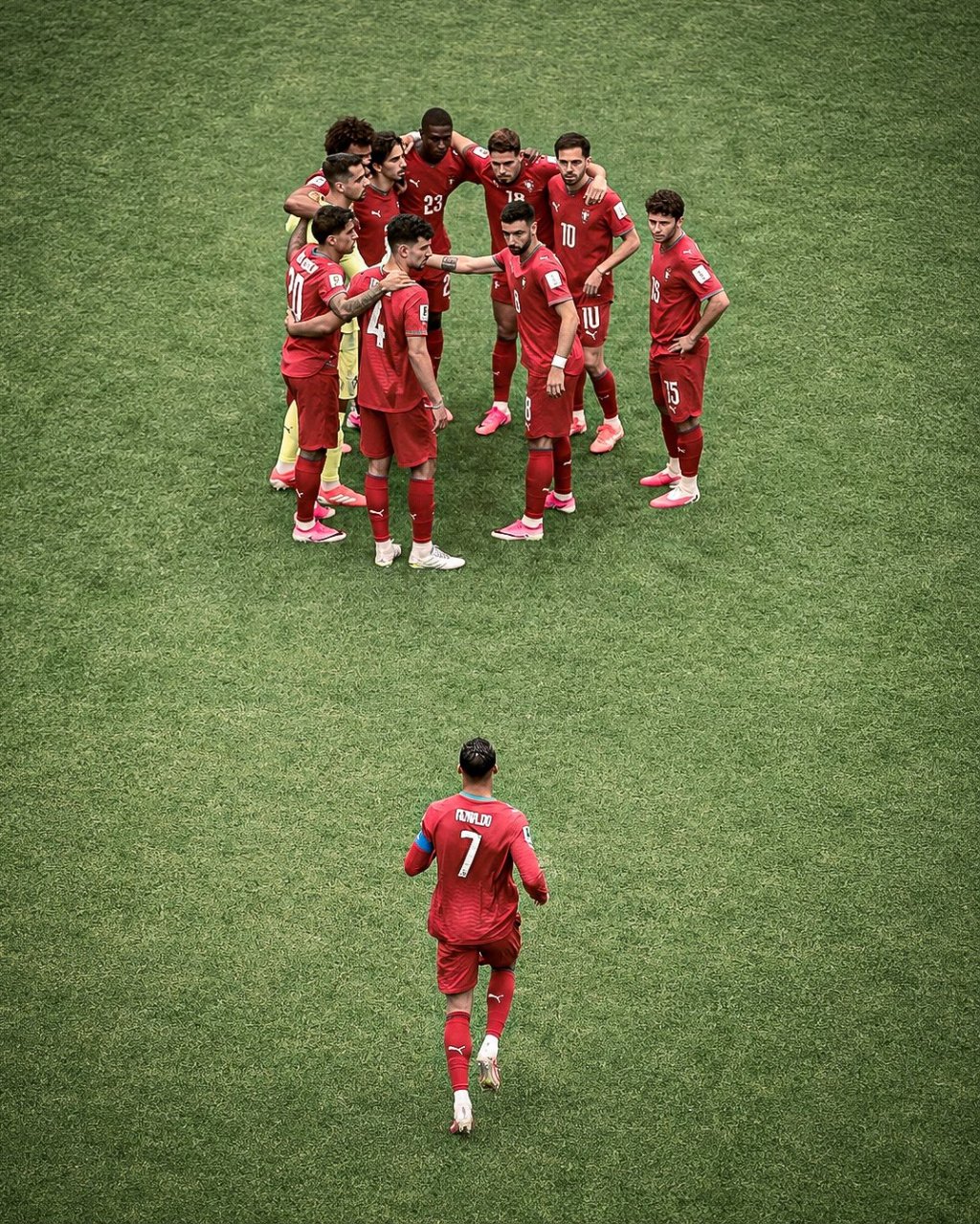
Ronaldo went out of the World Cup on Monday, crying, at 41, beaten by a goal in the 91st minute (MIKEL MERINO!). I kinda felt bad for him for about a day and then spent the rest of the week stuck on something else, which is that I have never worked out whether a player is allowed to be bigger than the team.
Everyone says no. It’s basically a commandment. Nobody is bigger than the club. Ferguson built 26 years on it. Sold Stam, sold Beckham at peak Beckham, moved Van Nistelrooy on while he was still scoring goals. Meanwhile the club’s best-selling product was a shirt with one man’s name on the back of it. So the commandment is a bit convenient, is all.
Here’s the thing I got stuck on.
Every team wants no single point of failure. Every person wants to be one.
Corporate people have a name for the first half of that. They call it the bus factor: how many people would have to get hit by a bus before the project dies. A bus factor of one means one person walks out and everything stops. It’s considered an emergency. Teams hold meetings about it. There are dashboards.
And in the same building, in a different meeting, someone is being told to make themselves indispensable.
That’s the whole thing, and I don’t think anyone’s ever put those two conversations in the same room on purpose. A good team is one where nobody matters too much. A good career is becoming the person the thing can’t run without. We tell people to be irreplaceable, then we build systems to make sure nobody is, and then we’re surprised when someone actually pulls it off and it becomes a problem.
There’s a cruel joke buried in it, too. Make yourself truly indispensable at work and you will not get promoted. You can’t be. You can’t be moved, because moving you breaks something. The reward for becoming the single point of failure is getting to stay exactly where you are, forever, being extremely important.
Anyway. Football.
The commandment is annoyingly well-supported. Bill Simmons named a whole theory after it – the Ewing Theory. Patrick Ewing was the Knicks. Everything went through him for fifteen years. Then in 1999 he got hurt in the playoffs and the Knicks, without him, went to the Finals. Simmons’ point was that this keeps happening: a team quietly gets better when the star goes, because the star had trained everyone around him to wait.
That’s the version of “too big for the team” nobody wants to say out loud. Not that the star was bad. That the ten others had slowly learned to stand still.
Which brings me to Arsenal, because of course it does.
We won the league this year. First time in 22 years, and we won it in the most anti-star way you could possibly design. 19 clean sheets. 27 goals conceded, best defence in the country. Someone on Sky called us “a team of corners and Gabriel goals,” meaning it as an insult, and I have decided to have it printed on a mug. Nobody carried us. In the Champions League final Arteta even started Havertz ahead of Gyökeres, the expensive summer signing, the actual marquee striker we craved for. Havertz scored in six minutes.
Bus factor: high. Textbook. 22 years of hurt ended by a team with no single point of failure.
And then Budapest.
1-1 after 120 minutes. Penalties. And it comes down to Gabriel, who had been our best player on the pitch, who had spent two hours throwing his body in front of everything PSG had, standing on the spot, alone, with the entire thing on him. He put it over the bar. Pulled his shirt over his face.
Twenty-six men build a season for ten months, and then football walks one of them out to a spot twelve yards from goal and makes him do it by himself in front of eighty thousand people.
That’s the part that broke my theory, and I’ve been sat with it for six weeks.
Because penalties aren’t a design flaw. The sport does that deliberately. You can build the perfect collective, the system with no weak link, the club where no one is bigger than the badge, and at the end, the game will still find the one man and put the whole thing on him. It insists on it. Every knockout tournament ends with the possibility of one person, alone, in silence, deciding everything.
So maybe the collective was never actually in charge and we just prefer the story where it is.
And I think that’s what sport is quietly for. It’s the last place we still say, with a straight face, that the badge matters more than the name. Everywhere else runs on the exact opposite rule. Your salary rewards being irreplaceable. Your promotion, your credit, whose name goes on the work. We spend every weekday trying to become the single point of failure, and then on Saturday we get morally offended watching someone succeed at it.
Ronaldo says Portugal won nothing before him. He’s right. He also went off injured 25 minutes into the 2016 final and they won it without him, and he was right there on the touchline, waving his arms, directing traffic, absolutely central to a thing that happened without him.
So which is it. Is he the reason, or was he standing nearby when it happened?
I don’t know, and I’ve stopped believing anyone who says they do. What I’ve noticed instead is that I’ve started checking my own bus factor at work, properly, honestly, and I don’t love the answer, and I’m not sure whether the thing I don’t love is that it’s too low or that it’s too high.


Leave a Reply